Stirling Council Archives Stirling Council Archives Department |
Stirling Council's Archives Service's main task is to acquire, preserve and make publicly available the documentary heritage of the Stirling Council area. Anyone may use the service and access the records free of charge.
Resources include Manuscripts, newspapers, maps, church records, administrative records and other key evidence for Stirling and the Stirling area since the fourteenth century. The staff can provide further information and guidance on local and genealogical enquiries. Jane Petrie of Archives gave a detailed presentation to the Society on the resources and support available to researchers in November 2011. View it here. Further details are available on the Stirling Council website. |
Archives Document of the Month November 2014
To give some idea of the archives available for access, we highlight a range of examples over the year by choosing a document of the month and publishing them on this local history web site.
The documents are selected by one of the members of staff at the Archives and help make visible the vast and varied historical sources available to researchers at the Archive.
The documents are selected by one of the members of staff at the Archives and help make visible the vast and varied historical sources available to researchers at the Archive.
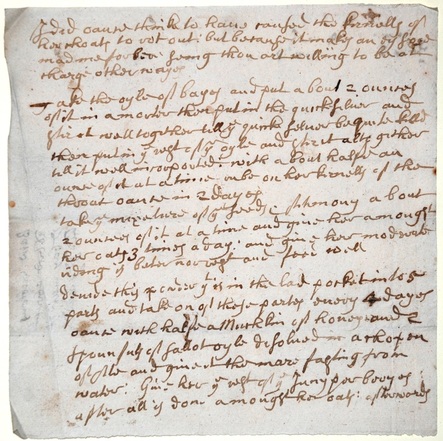 A 17th century recipe for the treatment of horses
‘Barte Gibson’s advice about the bay mare that had the glanders’ A 17th century recipe for the treatment of horses
This handwritten recipe was found amongst the papers of the Murray family of Polmaise held at the Archives. This fabulous collection of family papers dates from the 15th century to the 20th and has all kinds of information relating to both local and national events along with interesting family information that gives a wealth of detail about how the well-to-do lived during these times. The recipe is for the treatment of a horse with glanders. This was a very serious disease in horses caused by the bacterium burkholderia mallei ingested in contaminated food or water. The disease affected the lungs and respiratory tract causing lesions and ulceration and often led to septicaemia and death. Until the advent of antibiotics for veterinary use there was no reliable cure but this did not stop farmers and other horse owners from attempting to treat their animals if an infection was suspected. Thankfully, glanders is now eradicated in Europe, the last UK case being reported in 1928.
This recipe called for the use of quicksilver, another name for mercury. Although highly poisonous, mercury was used in human medicine quite frequently at this time in cures for syphilis and typhoid fever for example.
“I did oance think to have caused the firnells of
her choate to rot out: but because it makes an ey good
medicine forbei seing thou art willing to be at
charge other wayes
Take the oyle of bayes and put about 2 ounces
of it in a morter then put in the quicksilver and
stir it well together till the quick silver be quite killd
there put in the rest of the oyle and stir it altegither
till it well incorporated: with about halfe an
ounce of it at a time rube on her kirnells of the
throat oance in 2 dayes
take the mixature of the feed & Antimony about
2 ounces of it at a time and give her amongst
her oats 3 times a day: and give her moderate
riding is beter nor rest and feed well
devide this powder that is in the hay forkit into 5
parts and take on of these partes every 4 dayes
oance with halfe a Muchkin of honey and 2
spounfuls of sallot oyle dissolved in a chopen
of Ale and give it the mare fasting from
water: Give her the rest of the Junyper boug of
after all is done amongst her oats: afterwards
This handwritten recipe was found amongst the papers of the Murray family of Polmaise held at the Archives. This fabulous collection of family papers dates from the 15th century to the 20th and has all kinds of information relating to both local and national events along with interesting family information that gives a wealth of detail about how the well-to-do lived during these times. The recipe is for the treatment of a horse with glanders. This was a very serious disease in horses caused by the bacterium burkholderia mallei ingested in contaminated food or water. The disease affected the lungs and respiratory tract causing lesions and ulceration and often led to septicaemia and death. Until the advent of antibiotics for veterinary use there was no reliable cure but this did not stop farmers and other horse owners from attempting to treat their animals if an infection was suspected. Thankfully, glanders is now eradicated in Europe, the last UK case being reported in 1928.
This recipe called for the use of quicksilver, another name for mercury. Although highly poisonous, mercury was used in human medicine quite frequently at this time in cures for syphilis and typhoid fever for example.
“I did oance think to have caused the firnells of
her choate to rot out: but because it makes an ey good
medicine forbei seing thou art willing to be at
charge other wayes
Take the oyle of bayes and put about 2 ounces
of it in a morter then put in the quicksilver and
stir it well together till the quick silver be quite killd
there put in the rest of the oyle and stir it altegither
till it well incorporated: with about halfe an
ounce of it at a time rube on her kirnells of the
throat oance in 2 dayes
take the mixature of the feed & Antimony about
2 ounces of it at a time and give her amongst
her oats 3 times a day: and give her moderate
riding is beter nor rest and feed well
devide this powder that is in the hay forkit into 5
parts and take on of these partes every 4 dayes
oance with halfe a Muchkin of honey and 2
spounfuls of sallot oyle dissolved in a chopen
of Ale and give it the mare fasting from
water: Give her the rest of the Junyper boug of
after all is done amongst her oats: afterwards